
Europe has thousands of data centers, around 3,360 of them, spread across 45 countries. On paper that reads like infrastructure strength.
Then you look at what is actually inside them.
Most conversations treat "data center" as one thing, but then we misread the situation. In a simplified way, there are 4 types of data center workloads:
**1. General-purpose clouds** (websites, apps, databases, everything that ran before AI)
**2. Frontier training clusters** (where foundation models are built from scratch, one enormous machine running for months)
**3. Post-training, or "AI gyms"** (where trained models practice: reinforcement learning, synthetic data, evaluations)
**4. Inference centers** (where the finished model actually answers you, close to the user, always on)
Categories two and three are where models are made. Category four is where they deliver. Category one is what everything else still runs on top of.
Europe is mostly strong in the first category but only holds roughly 5% of global AI compute, while the US is at 75%.
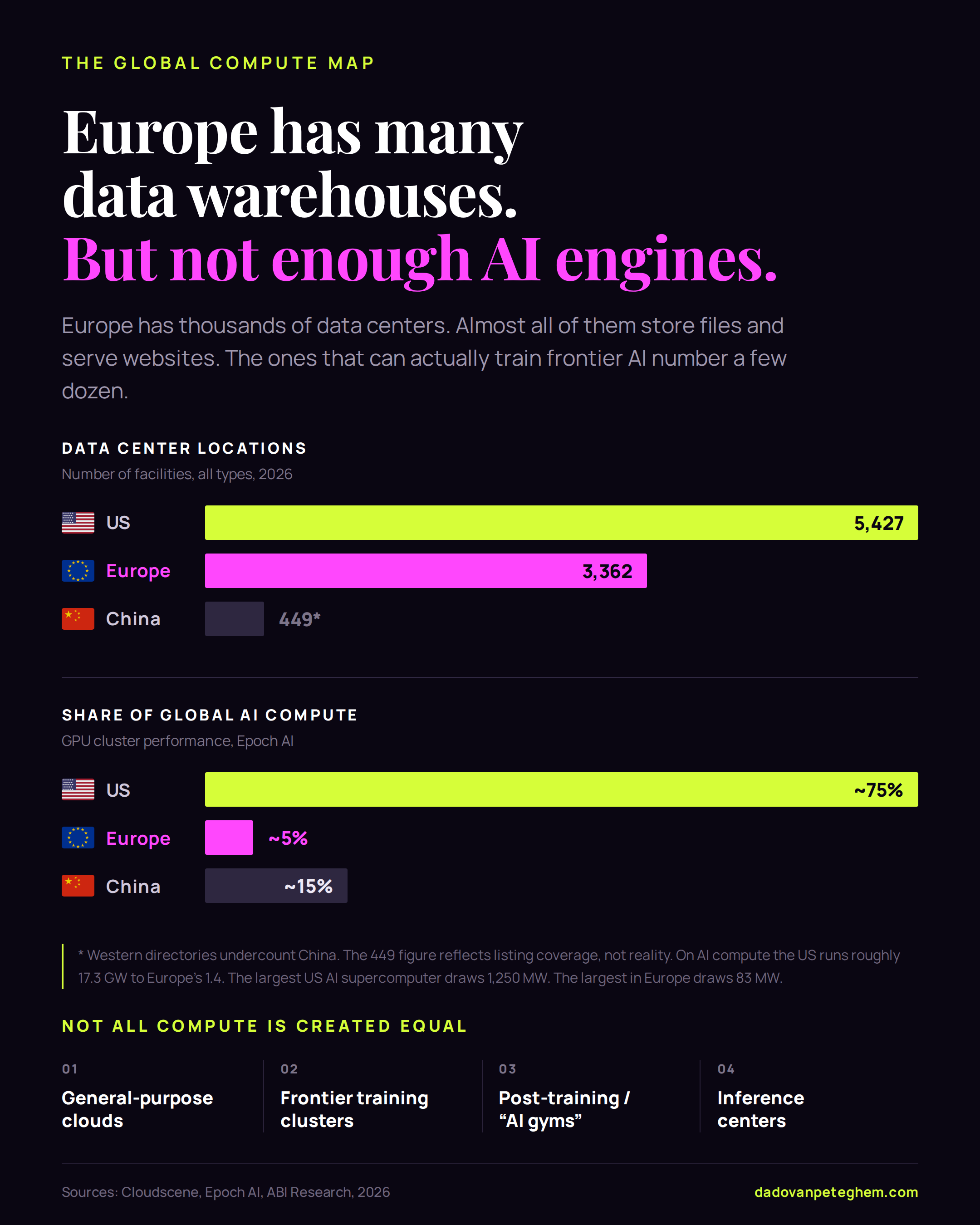
It would be easy to read the US numbers as a finished victory, but they are not.
American data center vacancy sits at roughly 1.4%. Almost everything that exists is already spoken for. The constraint has stopped being only capital and started being power, land, permits and local consent. In the first quarter of this year alone, four gigawatts of projects were postponed because of community opposition.
Compute is now a scarce physical resource with a queue. That changes the nature of the competition, as it is no longer a question of who can write the biggest check but who can actually get power to a site.
There is a live debate about whether the US has overbuilt.
The optimists answer a question about utilization: the facilities are full, absorption is strong, and every previous infrastructure overbuild in history, from railways to fiber, eventually became the backbone of the economy that followed.
The skeptics answer a question about returns. The Federal Reserve still sees the economic effects concentrated in a narrow slice of the economy.
Both can be true. The buildings can be full and the money can still not come back. "Fully used" and "worth it" are not the same claim.
But here is what matters for Europe: even if the US has overbuilt, that does not help us. Excess American capacity is still American capacity. It sits under American jurisdiction, subject to American export policy.
On the Moonshots podcast of Peter Diamandis, I heard the quote ‘If you can’t compete, you compute’. They made the point in the episode covering the temporary US suspension of Anthropic's Fable models: every country is going to have to conclude that it needs sovereign AI capability which cannot be switched off by another government.
The temptation is to spend on compute so that European companies can run international models closer to home. That is not sovereignty.
Sovereignty means being able to train, not just to serve. It means having the frontier training clusters and the AI gyms, not only the inference centers. Because the country that trains the model decides what the model knows, what it refuses and whose values are encoded in the post-training.
China is a case study. When the US restricted Nvidia’s top chips, China had no real choice but to build its own. The result is domestic silicon that is less advanced than TSMC and less capable than Nvidia, but which exists, works, and is now produced at meaningful scale.
Compute is the next race. Not because compute is the goal, but because compute is the precondition for everything downstream: the models, the agents, the products, and the ability to say no to someone else's terms.
You cannot fine-tune your way to independence on top of someone else's foundation. Europe does not need to win that race. It needs to be in it.
www.dadovanpeteghem.com